The Metallurgy of Japanese Shears
The foundation of precision hair architecture relies entirely on the structural integrity of the shear. When analyzing professional-grade cutting tools, the metallurgical composition dictates edge retention, corrosion resistance, and tactile feedback.
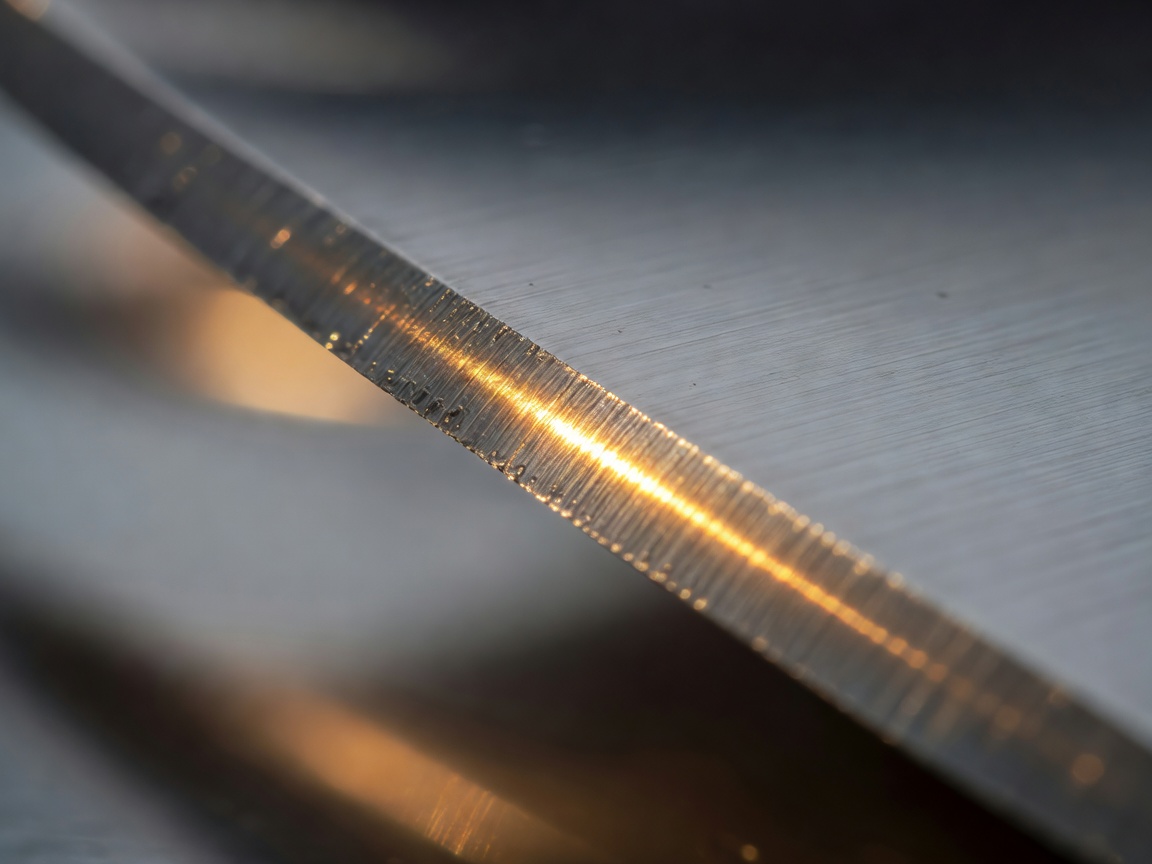
Alloy Architectures
Japanese steel is globally recognized as the paramount material for professional shears. However, "Japanese Steel" is a broad term encompassing various grades.
Hitachi 440C
The industry baseline for quality. 440C offers an excellent balance of hardness and rust resistance. It forms a reliable convex edge but requires more frequent sharpening schedules under high salon volume.
VG-10 (V Gold 10)
A high-carbon stainless steel integrating Cobalt, Molybdenum, and Vanadium. VG-10 achieves a Rockwell Hardness (HRC) of 60-61, allowing for a remarkably sharp, durable edge suited for slide cutting.
The ATS-314 Supremacy
Manufactured by Hitachi Metals, ATS-314 is technically a Cobalt alloy rather than traditional steel. The high cobalt matrix structuralizes the metal, resulting in unparalleled edge retention. An ATS-314 blade cuts through coarse hair with a buttery smoothness that other alloys cannot replicate.
Edge Geometry: The Convex Blade
Unlike the beveled edges found on German shears (which are durable but push hair), premium Japanese shears utilize a convex edge. Hand-honed to a gentle arc, the convex edge is razor-sharp. This geometry allows the blade to slice cleanly through the cuticle without microscopic crushing, preventing split ends.
Ergonomic Topography
The handle of the shear is as critical as the blade. A stylist's hand executes thousands of micro-movements daily.
- Opposing Grip: The oldest design. Symmetrical rings that force the thumb backward, often leading to carpal tunnel over a career.
- Offset Grip: The thumb ring is positioned shorter than the finger ring, relaxing the thumb tendon.
- Crane Grip: An extreme offset where the blade angles sharply downward from the handle, allowing the elbow to rest low against the body.